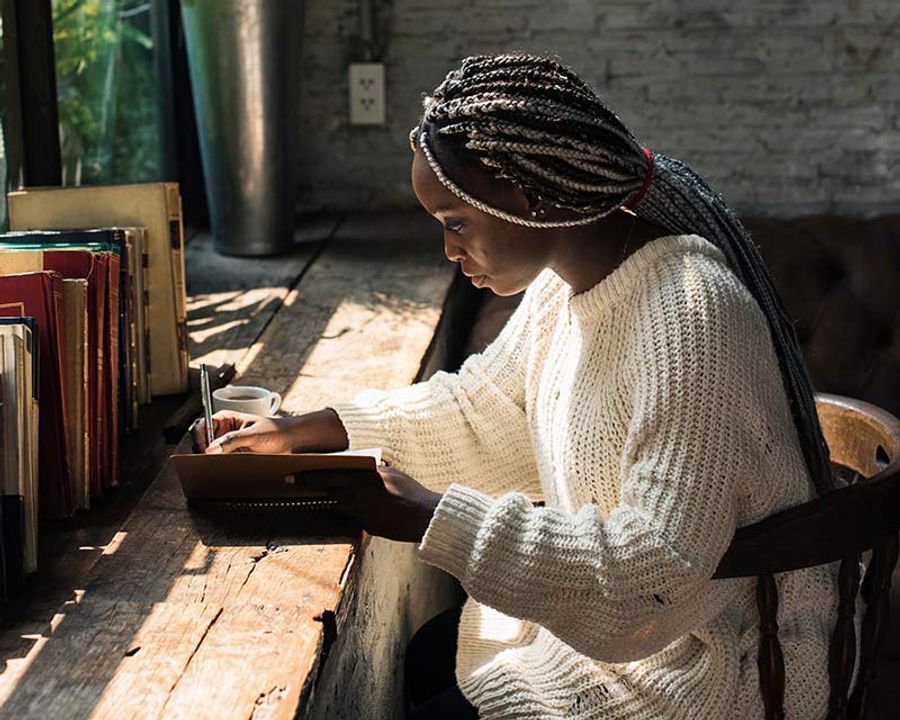
WOMEN IN LITERATURE
The Power of the Female Voice in Shaping Our World
Celebrating International Women's Day — March 8, 2026
A Voice That Refuses to Be Silenced
Words are never neutral. They carry history, rebellion, tenderness, and rage. For as long as human beings have used language to make sense of the world, women have been at the heart of that storytelling and yet, for centuries, their stories were dismissed, their manuscripts burned, their names erased or replaced by male pseudonyms. That silence was not natural. It was constructed.
This International Women's Day, March 8, 2026, we celebrate the writers who refused to stay silent, those who carved their names into the literary canon against every conceivable obstacle, and the millions of women today who continue to write, publish, and reshape the world through the radical act of telling their truth.
From the clay tablets of ancient Sumer to the digital pages of modern e-books, the female voice in literature has not merely survived — it has transformed how humanity understands itself. This is the story of that voice. This is a tribute to its power.
1. The First Words: Women Writers in the Ancient World
The oldest known author in recorded human history is a woman. Enheduanna, a high priestess and poet of ancient Sumer (c. 2285–2250 BCE), composed hymns to the goddess Inanna that are considered the first signed literary works in history. More than four thousand years before the printing press, a woman named her work, claimed her voice, and gave the world its very first author.
"Lady of all the divine powers, resplendent light, righteous woman clothed in radiance — Inanna!"
— Enheduanna, Hymn to Inanna, c. 2250 BCE
These early women writers remind us that the female literary voice is not a modern invention. It is not a product of the feminist movement, or the suffragettes, or the twentieth century. It is as old as writing itself. What changes across history is not whether women wrote — they always did — but whether the world chose to listen.
2. The Silencing: Medieval Walls and Renaissance Erasure
The medieval period presents a paradox. On one hand, the Church and patriarchal society formally restricted women's access to education, property, and public speech. On the other, a remarkable number of women wrote anyway in convents, in courts, in the margins of manuscripts that were never meant for them.
Hildegard of Bingen (1098–1179) was a German abbess, composer, scientist, and visionary writer whose theological works, musical compositions, and scientific texts on the natural world were staggering in scope.
Christine de Pizan (1364–c.1430) wrote The Book of the City of Ladies — a remarkable defense of women's intellectual and moral capacity — at a time when most women in Europe were forbidden from pursuing scholarly life.
"I am a woman, yet I dare to claim that where I was born matters less than the quality of my mind and my courage."
— Christine de Pizan, The Book of the City of Ladies, 1405
Yet for every woman who managed to write and be heard, hundreds more were silenced. The Renaissance, often celebrated as a golden age of human creativity, was in many respects a contraction of women's public intellectual life. As printing presses spread books across Europe, men controlled the presses. Women's manuscripts circulated in private — shared hand to hand, read aloud in salons, or locked away entirely.
The 'woman writer' became a category of suspicion. To write was to claim authority over language, over meaning, over truth — and authority was not for women. The literary canon that schoolchildren would be taught for the next five centuries was being assembled during this period, and it was assembled almost entirely without women.
3. The Great Disguise: Pseudonyms, Pen Names, and the Price of Publication
By the eighteenth and nineteenth centuries, the contradictions had grown almost unbearable. Society was producing educated women in greater numbers than ever before; women who read voraciously, who thought deeply, who had things to say that the world needed to hear. And yet, to publish under one's own female name was to court dismissal, condescension, or outright ridicule.
The solution was camouflage. Mary Ann Evans became George Eliot. Amantine Lucile Aurore Dupin became George Sand. Charlotte, Emily, and Anne Brontë published as Currer, Ellis, and Acton Bell. These women were not hiding from weakness. They were navigating a system that would have rejected their masterpieces — Middlemarch, Jane Eyre, Wuthering Heights — for no reason other than the sex of the person who wrote them.
The Brontë Sisters: A Family That Rewrote English Literature
The Brontë sisters occupy a unique space in literary history: three women, raised in the same household on the Yorkshire moors, who between them produced some of the most psychologically complex, emotionally ferocious novels in the English language.
Charlotte's Jane Eyre (1847) shook Victorian society with its insistence on a woman's inner life as worthy of epic treatment. Emily's Wuthering Heights (1847) created a gothic world of almost supernatural emotional intensity.
Anne's The Tenant of Wildfell Hall (1848) was a searing examination of domestic abuse and female autonomy so ahead of its time that it was suppressed after her death by Charlotte herself — perhaps a measure of how threatening it remained.
Jane Austen: The Quiet Revolutionary
Jane Austen (1775–1817) published anonymously, her novels attributed simply to 'A Lady.' She is now considered one of the greatest novelists in the English language, her six completed novels studied in universities on every continent. What makes Austen's achievement so extraordinary is not just the elegance of her prose or the precision of her social observation — it is the way she transformed the domestic sphere into a site of profound moral and psychological inquiry. In an era when women's lives were confined largely to the home, she showed that the home contained everything: desire, power, compromise, integrity, love.
4. The Modernist Revolution: Virginia Woolf and the Room of One's Own
No figure looms larger in the history of women and literature than Virginia Woolf (1882–1941). Her novels — Mrs. Dalloway, To the Lighthouse, The Waves — reinvented what prose fiction could do, fragmenting linear narrative to capture the interior landscape of consciousness in ways that had never been attempted before. But it is perhaps her extended essay “A Room of One's Own” (1929) that has done the most to shape how we think about women's relationship to literary creation.
"A woman must have money and a room of her own if she is to write fiction."
— Virginia Woolf, A Room of One's Own, 1929
Woolf's argument was material as much as metaphorical. Women's lack of access to education, economic independence, and physical space — a room of one's own — was not a personal failing but a structural condition enforced by centuries of legal and social inequality.
Shakespeare's sister, Woolf imagined, would have been just as talented as Shakespeare himself. But she would have been denied the education, the patronage, the freedom to roam London's theatres and taverns that helped Shakespeare become Shakespeare. She would have died unknown.
A Room of One's Own remains, nearly a century after its publication, one of the most essential texts for anyone thinking seriously about the relationship between gender, creativity, and power. It was named among the most important books of the twentieth century by multiple institutions.
Its central question, what would the world look like if women's creativity had never been suppressed? still does not have a complete answer.
5. Writing From the Margins: Women of Color and Intersectional Voices
The mainstream feminist literary tradition has historically cantered around white, Western, middle-class women's experiences. One of the most important developments in twentieth and twenty-first century literature has been the forceful claiming of space by women whose voices were doubly or triply marginalized — by race, colonialism, class, sexuality, disability, and more.
Toni Morrison: America's Conscience
Toni Morrison (1931–2019) was awarded the Nobel Prize in Literature in 1993, the first Black American woman to receive the honor. Her novels — Beloved, Song of Solomon, The Bluest Eye, Sula confront the legacy of American slavery with a prose style of extraordinary lyricism and moral seriousness.
Morrison did not soften her material for a white gaze. She wrote from within the Black American experience, for that experience, and in doing so created works of such universal power that they belong to all of human literature.
"If you have some power, then your job is to empower somebody else."
— Toni Morrison
Chimamanda Ngozi Adichie: The Story of Africa on Africa's Own Terms
Nigerian author Chimamanda Ngozi Adichie has become one of the most influential literary and intellectual voices of the twenty-first century. Her novels — Purple Hibiscus, Half of a Yellow Sun, Americanah — explore Nigerian history, identity, and the African experience with nuance and power.
Her TED Talk 'We Should All Be Feminists' (2012), adapted from a 2014 book, has been translated into dozens of languages and distributed to every sixteen-year-old in Sweden.
Her concept of the 'danger of a single story' that reducing any people to one narrative strips them of their complexity and humanity has reshaped how educators, journalists, and storytellers across the world think about representation.
Other Voices That Changed Everything
The twentieth and twenty-first centuries have produced a flowering of women's literary voices from every part of the world. Clarice Lispector from Brazil. Nawal El Saadawi from Egypt. Arundhati Roy from India. Sandra Cisneros from the Mexican-American tradition. Audre Lorde, whose insistence that 'poetry is not a luxury' but a necessity for women's survival became a rallying cry.
Maya Angelou, whose memoir I Know Why the Caged Bird Sings became one of the most widely read books in American literary history. Each of these writers expanded the boundaries of what literature could address, whose pain was worthy of the page, whose joy deserved to be celebrated.
6. The Body, Desire, and the Politics of Writing Women's Lives
One of the most persistently radical things a woman can do in literature is write honestly about her own body, sexuality, and desire. For centuries, women's physical experiences — childbirth, menstruation, sexual pleasure, sexual violence, aging were either absent from literature or filtered through the male gaze.
The reclamation of the female body as a site of literary authority has been one of the defining movements in women's writing.
Sylvia Plath's The Bell Jar (1963) broke open the experience of mental illness and female ambition in a society that had no language for what it was doing to young women. Anne Sexton and Adrienne Rich used poetry to dismantle the mythology of the perfect wife and mother.
Simone de Beauvoir's The Second Sex (1949) — a philosophical and literary landmark argued that 'woman' was not a biological destiny but a social construction, an 'other' defined always in relation to the male 'subject.'
In the twenty-first century, writers like Roxane Gay (Bad Feminist), Maggie Nelson (The Argonauts), Ocean Vuong, and Melissa Febos have continued this tradition of using personal experience as a lens onto larger social and political realities. The personal, as second-wave feminism declared, is political. And nowhere is more true than in literature.
7. Young Adult and Children's Literature: The Seeds of Tomorrow's Readers
It would be impossible to discuss women and literature without celebrating the extraordinary women who shaped the imaginations of children and young people. Louisa May Alcott's Little Women (1868) gave generations of girls a model of female intellectual ambition in the character of Jo March.
L.M. Montgomery's Anne of Green Gables (1908) created perhaps the most beloved girl protagonist in English literature. Beverly Cleary, Judy Blume, Madeleine L'Engle — these writers built the inner lives of countless readers.
Today, women dominate young adult literature. Malorie Blackman, Jacqueline Woodson, Angie Thomas (whose novel The Hate U Give sparked national conversations about race and police violence), and many others are writing books that help young people make sense of injustice, identity, and belonging. These books matter. The stories we give children are the stories that form them.
8. The Digital Age: New Platforms, New Voices, New Possibilities
The internet has done something remarkable for women's literary voices: it has created spaces that bypass traditional gatekeepers entirely. Self-publishing platforms, literary blogs, poetry communities on social media, writing collectives on Substack and Medium.
Women are finding readers in numbers and through channels that Virginia Woolf could never have imagined.
Rupi Kaur's milk and honey (2014), initially self-published and promoted through Instagram, became one of the best-selling poetry collections in decades, introducing millions of young people, particularly young women, to poetry as a form of processing trauma, love, and identity.
Amanda Gorman's recitation of 'The Hill We Climb' at the 2021 U.S. presidential inauguration made her the youngest inaugural poet in American history and ignited a global conversation about the power of poetic language in public life.
Fanfiction communities, many of them dominated by women and queer writers, are producing millions of words of creative fiction that experiments with form, representation, and storytelling in ways that are genuinely innovative. The question of what 'counts' as literature is being renegotiated in real time, and women are at the centre of that renegotiation.
Challenges Remain
Despite these advances, significant inequalities persist in the publishing industry. Women are still underrepresented in literary prize shortlists, reviewed less frequently in major literary publications, and paid less on average for book advances than their male counterparts.
Women writers of colour face compounded barriers. Trans and non-binary writers face additional layers of marginalization. The digital revolution has lowered some barriers while others remain stubbornly in place.
9. Ten Women Writers Who Changed the World
In celebration of International Women's Day 2026, here is a brief tribute to ten women whose literary contributions transformed not just literature but how we understand what it means to be human.
1. Jane Austen (1775–1817)
Redefined the English novel as a space for moral and psychological inquiry. Six novels. Countless millions of readers. Eternal relevance.
2. Mary Shelley (1797–1851)
Wrote Frankenstein at nineteen. Invented science fiction. Raised questions about creation, responsibility, and what it means to be human that are more urgent in 2026 than they have ever been.
3. George Eliot (1819–1880)
Middlemarch is widely considered the greatest novel in the English language. Eliot's psychological depth and moral seriousness set a standard that literature has been reaching toward ever since.
4. Virginia Woolf (1882–1941)
Revolutionized the novel with stream-of-consciousness technique. Argued for women's right to creative space and economic independence in terms that have never lost their urgency.
5. Simone de Beauvoir (1908–1986)
The Second Sex laid the philosophical foundations for modern feminism. De Beauvoir's analysis of how 'woman' is constructed as 'other' remains the starting point for feminist theory.
6. Toni Morrison (1931–2019)
Nobel laureate. Author of Beloved — arguably the greatest American novel of the twentieth century. Morrison's work confronted the brutal truths of American history with beauty and moral force.
7. Maya Angelou (1928–2014)
Poet, memoirist, civil rights activist. I Know Why the Caged Bird Sings gave voice to experiences that had been kept in silence. Her words have brought comfort to millions.
8. Chimamanda Ngozi Adichie (1977–)
One of the most important writers of our time. Her novels and essays have reshaped global conversations about feminism, African identity, and the politics of storytelling.
9. Audre Lorde (1934–1992)
Black, lesbian, feminist, warrior, poet. Lorde's insistence on the interconnectedness of all forms of oppression, and the necessity of speaking, laid the groundwork for intersectional feminism.
10. Nawal El Saadawi (1931–2021)
Egyptian physician, novelist, and feminist whose work on gender and sexuality in the Arab world made her a figure of international controversy and enduring importance. She was imprisoned, exiled, and threatened. She never stopped writing.
10. Why Literature Still Matters: The Political Act of Reading Women
In an age of social media, streaming, and algorithmic content, the question of why we should read women and why we should read at all deserves a serious answer. Literature does something that no other medium does quite so completely: it takes you inside another person's mind. It asks you to inhabit an experience not your own, to feel another life from the inside.
When we read women writers, particularly women whose experiences differ from our own, we expand our understanding of what human life contains. We encounter forms of suffering and resistance that might otherwise remain invisible.
We discover that experiences dismissed as 'merely personal' — childbirth, domestic labor, the management of male anger, the navigation of one's own desire in a world that would suppress it are in fact among the most politically charged and universally significant experiences there are.
Reading women is, in this sense, a political act. So is publishing women, reviewing women, assigning women's work in schools and universities, and insisting that the literary canon reflect the full breadth of human experience.
The ongoing struggle to make women's voices heard in literature is part of the larger struggle for justice, equality, and the recognition of the full humanity of more than half the world's population.
"There is no greater agony than bearing an untold story inside you."
— Maya Angelou, I Know Why the Caged Bird Sings
In Closing: March 8, 2026 — The Story Continues
On this International Women's Day 2026, we celebrate not only the great women writers of history but the writers who are working right now, the novelist finishing her manuscript at midnight after the children are asleep, the poet posting her work to a small but devoted readership, the journalist whose investigation might change policy, the young woman who is writing her first story and does not yet know what it will become.
The female voice in literature has survived every attempt to silence it. It has survived censorship, ridicule, poverty, pseudonymity, exclusion from institutions, and the daily attrition of a world that often fails to take women's inner lives seriously. It has not merely survived, it has flourished, diversified, and deepened into something immeasurably richer for every obstacle it has overcome.
The story is not finished. There are still voices waiting to be heard, stories waiting to be told, rooms of one's own that have yet to be claimed. But if history teaches us anything, it is this: those voices will not stay silent. They never have.
Read. Listen. Amplify. Celebrate.